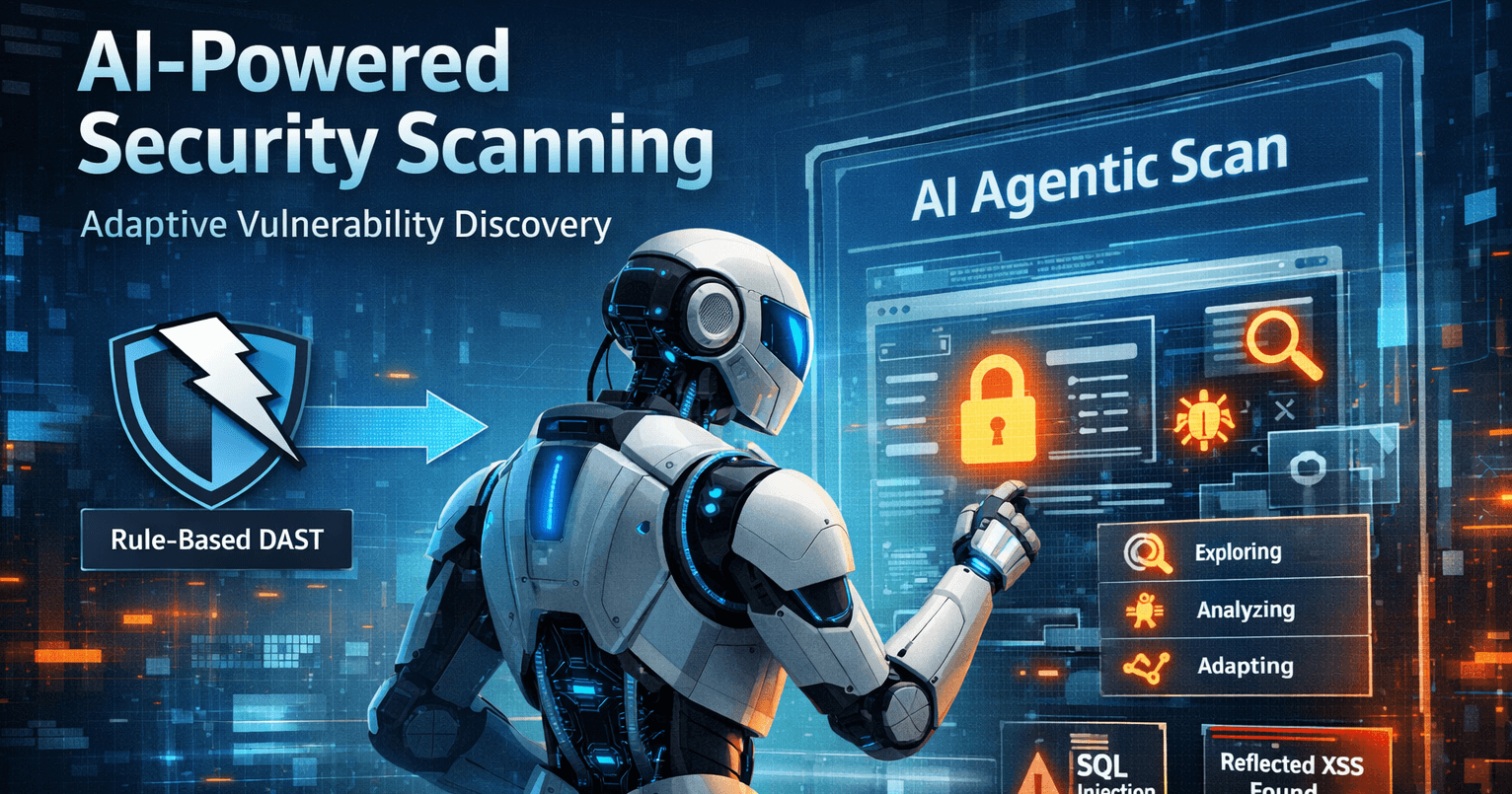
AI-powered security scanning (also called AI Agentic Scan or agentic DAST) uses an AI agent to explore your application, reason over HTTP responses, and adaptively probe for vulnerabilities like XSS, SQL injection, and misconfiguration. Unlike rule-based DAST, the agent decides what to try next based on what it learns—here's how it works and when to use it with tools like OWASP ZAP.
Quick definition
AI Agentic Scan is a form of dynamic application security testing (DAST) where an AI model drives the scan. It explores your app, reasons over each response, and adaptively probes for vulnerabilities—instead of running a fixed set of rules.
What is AI-powered security scanning?
AI-powered security scanning (sometimes called AI Agentic Scan or agentic DAST) uses an AI model to drive the testing process. Instead of executing a fixed sequence of rules and payloads, the agent explores your application, inspects HTTP responses, and decides what to probe next. It can reason about whether a response indicates a vulnerability, adapt its strategy when it finds something interesting, and explore paths that traditional scanners might not cover.
The key difference from traditional DAST is adaptivity. A rule-based scanner runs through a known list of checks; an AI agent can synthesize information from multiple responses and try new approaches on the fly. That makes it well suited for discovering issues that don't fit neatly into predefined patterns—or for providing an extra pass after a traditional scan to catch what might have been missed.
AI Agentic Scan vs rule-based DAST: comparison
OWASP ZAP and similar tools use a fixed set of rules. AI Agentic Scan adds adaptive, reasoning-driven coverage. Here's how they compare:
| Aspect | Rule-based DAST (e.g. OWASP ZAP) | AI Agentic Scan |
|---|---|---|
| Approach | Fixed rules and payloads | Adaptive exploration |
| Decision-making | Runs predefined checks | Reasons over responses, decides next steps |
| Speed | Fast, predictable | Slower (model reasoning per request) |
| Coverage | Well-known patterns, battle-tested | Unexpected behavior, context-dependent issues |
| Best use | Baseline, CI, scheduled scans | Supplement before releases, deep passes |
Rule-based DAST is like a checklist; AI Agentic Scan is like a skilled tester who improvises. Use both: the checklist ensures nothing obvious is missed; the improvisor spots things the checklist wasn't designed for.
What does AI Agentic Scan probe for?
AI Agentic Scan typically focuses on the same classes of vulnerabilities as traditional DAST, but with an adaptive approach:
- Reflected XSS. The agent looks for parameters that are echoed in the response and probes whether they can be used to inject script. It can reason about encoding, context (HTML vs. JavaScript), and whether a payload actually executed.
- SQL injection. It sends payloads and analyzes responses for signs of successful injection—error messages, different result sets, or timing changes. The AI can decide when a response is suspicious and worth further probing.
- Security headers and misconfiguration. It checks for missing or weak headers (CSP, HSTS, X-Frame-Options, etc.) and common misconfigurations. Reasoning over response structure helps it identify when something is off.
- Other injection and reflection. Command injection, LDAP injection, and similar issues can be probed adaptively when the agent infers that input is used in a risky way.
Because the agent reasons over responses, it can reduce noise: it may avoid flagging things that clearly aren't exploitable, and it can pursue leads that look promising instead of blindly running every possible check.
When to use AI Agentic Scan
AI Agentic Scan works best as a supplement to traditional DAST, not a replacement. Here's a practical approach:
- Run traditional DAST first. Use OWASP ZAP (or similar) for broad, rule-based coverage. It's fast, well-understood, and catches the majority of known issues.
- Add an AI pass for adaptive discovery. After your baseline scan, run an AI Agentic Scan. It can explore the same target with a different strategy and surface issues that the rule set didn't catch.
- Use it before major releases or pentests. When you want extra assurance—before a launch or before bringing in a penetration tester—an AI pass can help you find and fix more issues proactively.
AI scanning is typically more resource-intensive than rule-based scanning (each request involves model reasoning), so it's often used selectively—on high-value targets or as a periodic deep pass—rather than on every scan in CI.
Limitations and best practices
AI-powered scanning is powerful but not magic. Keep these in mind:
- It doesn't replace rule-based DAST. Traditional tools have years of tuned payloads and checks. Use both.
- Coverage varies. The agent explores adaptively, so it may not touch every endpoint. Pair it with good crawl coverage or an API spec when testing APIs.
- Review findings like any other. AI can produce false positives or miss issues. Treat its output as input to your triage process, not as a final verdict.
- Consider cost and time. AI scans can take longer and use more compute. Use them where the extra depth is justified.
Key takeaways
- AI Agentic Scan uses an AI agent to adaptively probe for XSS, SQL injection, and misconfigurations.
- It supplements—does not replace—rule-based DAST like OWASP ZAP. Run both for best coverage.
- Use AI scans selectively (before releases, high-value targets) since they are more resource-intensive.
- Review findings like any scan: AI can produce false positives or miss issues.
Wrapping up
AI-powered security scanning brings adaptive, reasoning-driven exploration to vulnerability discovery. It complements rule-based DAST by probing in ways that fixed checklists might not. For teams already using OWASP ZAP or similar tools, adding an AI Agentic Scan as a supplementary pass is a practical way to get more coverage without replacing what works.
Scryn offers both traditional DAST (powered by OWASP ZAP) and AI Agentic Scan in the same platform. Run a baseline scan with ZAP, then add an AI pass for adaptive discovery—all from one dashboard. Try an AI Agentic Scan on a target you've already tested with a standard scan and compare the findings.